what to wear as a guest to sacred thread ceremony

"As a member of that customs, with a identify in the web of history, he would now be able to learn from anybody and everybody."
Photo by Raymond Williams
"Life is a relay race of generations. It requires that things be passed, at times rather desperately, from one generation to the next. At the to the lowest degree, it is the transfer of a tool, a skill, a craft; at its grandest and about dangerous because nigh vulnerable, it is a way of seeing the earth—a globe that goes on and on, seen from a life that is once and merely."

Mag
Winter/Spring 2002
The Sacred Thread
Professor Raymond Williams H'68 is talking most the lotus—the national symbol of India.
"Its petals are beautiful, just it emerges from the mirkiest, dirtiest h2o there is. The lotus transforms that.
"People who visit Bharat either become enamored of the blossom, or repulsed by the water. I became intrigued by the dazzler, the colour, the pageantry, and the lovely people—so generous, so hospitable."
That hospitality, Williams' scholarly work—and a budding friendship with the Hindu acharya [esteemed religious teacher] Tejendraprasad (Tej) Pande— brought the professor to a singularly auspicious occasion in the life of the Swaminarayan Hindu sect he's studied for about iii decades. In 1981, he was an honored invitee at the sacred thread ceremony for the acharya's seven-yr-old son, Koshalendraprasad (Kosh). Celebrated on the 200th anniversary of the birth engagement of the sect'due south founder, the rite would marker Kosh'due south initiation every bit a religious student, a stage through which every Brahmin son must pass. But this was the initiation of an acharya'due south son and, as the professor recalls, thousands thronged to the temple at Amdavad to participate:
It was clearly a momentous event for the whole community. I passed through a huge crowd to enter the gates and into the courtyard of the haveli, which was surrounded past four stories of balconies, each packed with onlookers. A slice of lite from a slit in the roof covering slanted from the ceiling to the flooring. It was hot—well over 100 degrees—and the anniversary was already in progress.
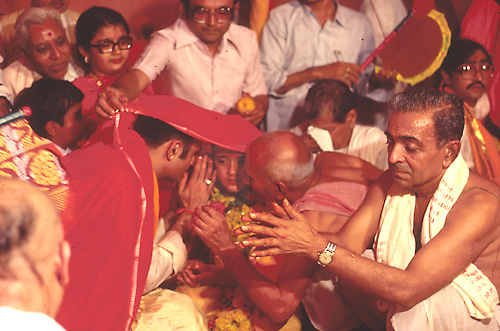
Kosh saturday on the covered floor with his father, surrounded by other religious specialists and family unit members. A strand of thread stretched from Kosh to a canvass screen, behind which his mother sat. As the married woman of the archarya, she is never seen in public past anyone except family unit members, but she is a religious specialist in her own right.
Sacrifices were offered in a sacred burn down, with celebrants instructed when to toss grains, oil, or ghee, into the flames. Kosh and his 2 cousins, too being initiated, were bathed, still wearing their undergarments, subsequently their heads were shaved.
And so Kosh was dressed in the clothing of a wandering student. Much of the symbolism of the ceremony reflected his entrance into the written report of sacred texts. Before modern times, a brachmachari [student] was expected to go out dwelling and wander the countryside, learning from wise men in temples and ashrams. Like near mod brahmachari, Kosh would exist learning at home and in a local school. (In a pre-planned role of the ritual, his uncle convinces him to stay!) But, equally is the tradition, he was handed a staff for his journey and sacred books for study.
During the more than three-60 minutes ritual in that location was plenty of noise, plenty of coming and going. But there came a time when things became very tranquillity. Tej had placed the sacred thread on Kosh's shoulder. And then, as a fabric was held over Kosh and his father, Tej leaned forward, raised his hands to his lips, and whispered the Swaminaryan mantra into his son'south ear.
The ceremony continued. Well-wishers came forward with gifts of habiliment and nutrient.
Only the transformation was complete. By whispering the mantra and performing the initiation, Tej had "opened the book" for Kosh— he set his son on a path to seek wisdom not only from his family unit and sacred scriptures, but from other teachers, every bit well. As a member of that community, with a place in the web of history, he would now be able to learn from anybody and everybody. In fact, he went on to study at St. Xavier School and St. Xavier College in Amdavad, from which his father had graduated.
Wabash biologist Robert Fiddling once noted that "[life is] a relay race of generations. It requires that things, which in themselves are insignificant, be passed, at times rather desperately, from one generation to the next. At the least, it is the transfer of a tool, a skill, a craft; at its grandest and near unsafe considering well-nigh vulnerable, it is a way of seeing the world—a globe that goes on and on, seen from a life that is once and but."
The sacred thread ceremony is a life-changing moment for a Brahmin boy. Still I run across it every bit a metaphor for both the fact that learning takes place in a customs and that the customs values, sustains, and mines the wealth of tradition, which enables the customs to abound in wisdom. It illumines for me our work in the College. Like the newly initiated brahmachari, the student arriving at a liberal arts college becomes a member of only such a community, where the faculty preserves what is past, refines and works it, and uses the by as a way of pushing towards the future.
Whether it takes place in a religious customs or at a liberal arts college, the "opening of the book" is a beautiful affair.
Edited and excerpted from an interview with Raymond Williams, Wabash faith professor, writer of An Introduction to Swaminarayan Hinduism, and manager of the Wabash Eye for Teaching and Learning in Theology and Religion.
Return to INCENSE
Render to the table of contents
Source: https://www.wabash.edu/magazine/2002/WinterSpring2002/sacredthread.html

Post a Comment for "what to wear as a guest to sacred thread ceremony"