What to Do With Beef Broth Fat
How To Make Os Broth in the Instant Pot
Nosotros independently select these products—if you purchase from one of our links, we may earn a commission. All prices were accurate at the time of publishing.
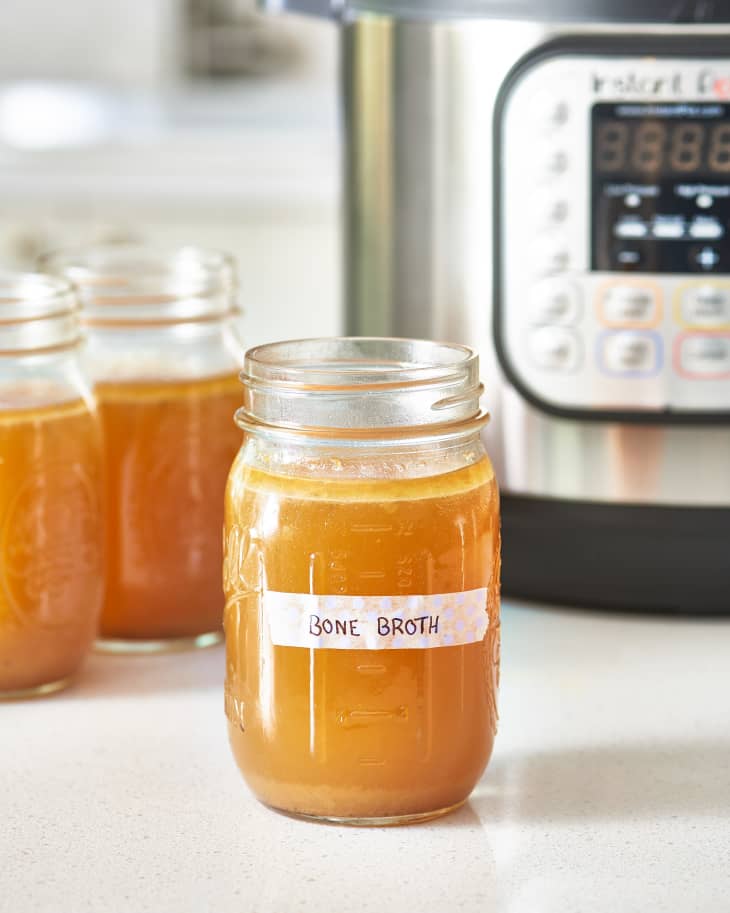
Traditional stovetop bone broth takes a minimum of 24 hours, but ideally more like 48 hours to transform a pot of h2o, acid, and collagen-rich basic into a deep, golden-brown liquid with a texture like barely set jello. Truth is, when y'all cook bone broth on the stove for that long y'all and your house will smell like beef goop for days. The skilful news is there is another way.
Broth in an electric pressure level cooker tin can feel like zip short of magic, but cooking broth nether pressure is a technique that professional kitchens and wise home cooks have been using for decades. Cooking the bone broth in a closed environment and under force per unit area speeds upwards the process, which means you can become from basic to luxurious goop in about 8 hours — most of which is still hands-off. In this cooking lesson, we're going to show you the simplest mode to do but that with beef or craven bones.
What Is Bone Broth?
Bone broth is substantially a long-cooked stock. It'south most often made with beefiness or chicken basic and cooked until the bones release gelatin and collagen that thickens the broth, giving it a gelled texture. Bone broth is slightly different from stock, in that it's cooked significantly longer with a petty acidity (normally vino or vinegar) to help suspension down the bones.
We've explored the question of whether bone broth is expert for you and found that while information technology does comprise a measurable amount of poly peptide per cup, 1 of the existent boons of bone broth is that it teaches you the essential culinary technique of stock-making.
Whether you plough it into restorative soups, luxurious sauces, or drinkable information technology as an afternoon pick-me-upward, all these reasons prove that bone broth is here to stay.
For Your Data
- Bone broth requires meaty, collagen-rich bones. You can utilise beef or chicken bones or a combination of the two. For the richest goop, we suggest oxtail, marrow bones, and fifty-fifty short ribs for beefiness, and wings for chicken.
- This bone broth is three-step procedure: Beginning the bones are roasted, then the bones are cooked under pressure. The vegetables are added, and and then bone broth is cooked under pressure once more.
- What to expect from timing: For the first round of pressure level cooking, expect the force per unit area cooker to accept about 1 60 minutes to come to force per unit area, cook on high for ii hours, and so take ane 1/2 hours for the natural release of steam. Once the vegetables are added, the second round of cooking volition take less time to come to pressure level. Yous volition melt the goop again at this point for another 2 hours.
Key Steps for Bone Broth in the Instant Pot
- Roast the bones. Flavor, season, season is what roasting is all about, merely information technology has an actress benefit of adding color to the concluding broth. Roasting also cuts down on the foam associated with boiling bones.
- Add vinegar and de-foam the bones. Supposedly soaking the bones with vinegar helps release minerals from the broth, according to the experts at Brodo, a goop-focused restaurant with locations throughout the Northeast. After the bones are roasted, move them to the force per unit area cooker and cover with cool h2o and add together the vinegar. Bring these to a simmer using the sauté function. Employ a wide spoon to skim off any cream.
- Melt for 2 hours on HIGH. The first round of pressurized cooking is for ii hours. The Instant Pot tin take up to an hour to come to full pressure. Apply the manual or soup setting to cook on high pressure level for 120 minutes.
- Utilize natural release to avoid sputtering and cook the stock longer. "Natural release" in pressure cooker recipes but means that instead of opening the steam valve to chop-chop release the pressure, just let the pot slowly release the pressure level on its own. Natural release is most often chosen for in broths and soups to foreclose spurting of hot liquids from the valve. Hither it does double duty, giving the broth a longer cook time, which means more extraction.
- Add the vegetables halfway through cooking. When the 2 hours are upwards, let the pressure cooker naturally release by leaving the steam valve as is until the pressure subsides. This will accept most xc minutes. When the force per unit area's up, add the vegetables. Adding the vegetables later in the cooking process keeps the goop from tasting bitter. Don't skip calculation the vegetables all together — they add together colour and sweetness to the finished broth.
- Chill the broth quickly. In professional kitchens, broth chilling is serious business concern. It keeps the broth from hanging out in the temperature danger zone and won't heat up the fridge. Fill a sink or big basin with water ice water and strain your stock into some other pot or mixing bowl that sits down in the ice bath. Personally I find my stand up-mixer basin is the perfect shape and size for chilling finished broth.
Storing and Using Os Broth
As with whatsoever broth, information technology's best practice to chill the broth as speedily every bit you can after making it. I like to turn my sink into an ice bathroom with water and ice and strain my broth into a thin pot or my stand mixer'south bowl and fix the bowl in the ice bath to absurd to room temperature before storing. Quick spooky keeps goop out of the bacterial danger zone and prevents it from heating up your fridge or freezer. Your broth volition taste better and last longer considering of this step.
Bone goop keeps well in the fridge for upward to a week or can be frozen for three months. Chilled bone broth has a thick, jello-like thickness and a rich amber color. Don't worry if in that location'due south a layer of thick, white fat covering the top of the broth. Yous tin skim this off and use it for cooking vegetables or grains — or leave information technology for a richer soup broth.
Use os broth anywhere you might use broth for cooking — as a base for soups, to deglaze pans, and to make sauces. I've been heating mine upwards with a little garlic and ginger instead of my afternoon cup of tea.
- booze-free
- egg-gratuitous
- dairy-complimentary
- kidney-friendly
- fish-free
- peanut-gratuitous
- low-potassium
- shellfish-free
- pork-free
- sugar-conscious
- gluten-free
- tree-nut-free
- soy-free
- wheat-complimentary
- depression-sodium
- no-oil-added
- depression-carb
Per serving, based on
two
servings. (% daily value)
- Calories 23
- Fat 1.3 g (2.0%)
- Saturated 0.5 g (ii.seven%)
- Carbs 0.v yard (0.2%)
- Fiber 0.one g (0.4%)
- Sugars 0.iii g
- Protein 2.0 g (4.one%)
- Sodium 27.4 mg (1.i%)
Ingredients
- 2 pounds
beefiness bones, such equally oxtail, marrow basic, or short ribs, or 3 pounds chicken bones, (at to the lowest degree one pound wings)
- 2 tablespoons
apple cider or white wine vinegar
- 1
large onion, quartered
- i
large carrot, peeled
Equipment
-
6- to viii-quart electric pressure cooker
-
Baking sheet
-
Scale
-
Chef'south pocketknife and cutting board
-
Fine-mesh strainer or colander
Instructions
-
Preheat the oven to 400°F and rinse the bones. Adjust a rack in the middle of the oven and oestrus the oven to 400°F. Place the bones in a colander, rinse under absurd water, and pat dry with paper towels.
-
Roast the bones for 30 minutes. Arrange the basic in a unmarried layer on a rimmed baking sheet. Roast until golden-dark-brown, about xxx minutes.
-
Bring the basic and cider vinegar to a boil, skimming the elevation. Transfer the basic to a 6-quart or larger Instant Pot or electrical force per unit area cooker and add 3 quarts filtered water. Add the vinegar and use the Sauté function to bring the broth to a boil. When the broth comes to a simmer, use a wide slotted spoon to remove any white or gray foam off of the top.
-
Melt on high force per unit area for 120 minutes. Cover and lock on the pressure cooker lid. Brand sure the pressure-release valve is airtight. Set to manual, high pressure for 120 minutes. The quickest way to 120 minutes is to actually press the (-) until the clock hits zilch and then 120 minutes.
-
Naturally release the pressure. When the 120 minutes is upwards, let the pressure level cooker naturally release all the pressure. Do not adapt the steam valve. This volition take nearly 90 minutes.
-
Add the onion and carrots and cook over again on high for 120 minutes. Open the pressure cooker and add the onion and carrot. Encompass and lock the lid back on. Brand sure the force per unit area-release valve is closed. Set to manual, high pressure for 120 minutes.
-
NatNaturally release the force per unit area. When the 120 minutes are up, let the pressure level cooker naturally release all the pressure level. Practice non adjust the steam valve. This will accept virtually ninety minutes.
-
Strain the bone broth. When the goop is finished, strain and cool the bone goop as quickly as possible. Set up a strainer over a large pot or even a stand up mixer basin. Advisedly strain the bone broth into it. Discard the contents of the strainer.
-
Cool the bone goop and store. Fix an ice bath past either filling a sink or basin with cold water and ice and fix the pot of broth inside the ice bath. Stir regularly until the broth is cooled to about l°F, well-nigh 15 minutes. Transfer the broth to airtight containers or jars. Refrigerate or freeze.
Recipe Notes
Basic for bone broth: You can use whatsoever mix of beefiness, pork, or craven bones for making os broth. Calculation some meaty basic, like brusk ribs or ham basic, will make a richer-tasting broth; you can also use the meat from the bones in other dishes.
Filtered water: We used filtered water for more neutral testing. If you've got great-tasting tap or well water, experience free to use information technology here. Water filtered with a filter or faucet filter works well; bottled filtered h2o is not required.
Storing and reheating: The broth tin be refrigerated for up to 5 days or frozen for upwardly to 3 months. To reheat, cascade out as much broth equally y'all'd similar and reheat it gently on the stove or in the microwave.
Reducing bone goop for storage: To save on freezer space, you tin simmer the broth over low estrus on the stovetop until it's reduced by half. Keep it at a very bare simmer — you lot should see just a few bubbles as it simmers. Make a notation on the freezer container that the broth needs to be thinned with h2o before using.
Source: https://www.thekitchn.com/beef-bone-broth-in-an-electric-pressure-cooker-254170
Post a Comment for "What to Do With Beef Broth Fat"